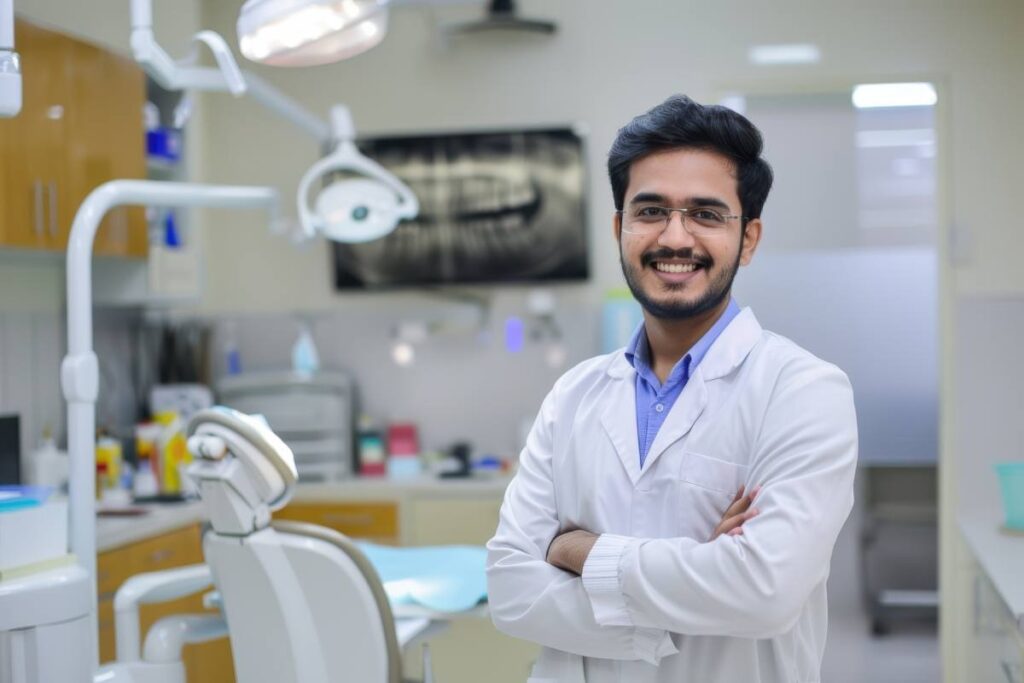
- MDS Maxillofacial Surgery is the Changing Face of Surgical Precision
- DJ Dental College: Blending Human Expertise with Machine Intelligence
- AI Tools Empowering Tomorrow’s Surgeons
- The 3D Printing and Robotics Integration
- Training the Mind, Not Just the Hands
- Research and Real-World Impact
- From the Classroom to the Operating Room—and Beyond
- Final Thoughts: A Future in Safe, Skilled Hands
Long at the nexus of medicine and art, maxillofacial surgery addresses not only the physical restoration of the face and jaws but also the psychological and functional changes in life. This field of MDS maxillofacial surgery is seeing one of the most innovative changes in its history right now. Artificial intelligence (AI) is already influencing our diagnosis, planning, and execution of difficult surgeries; it is not a concept of the future.
At the core of this revolution is a growing centre of excellence: the Department of Oral & Maxillofacial Surgery of DJ Dental College, a destination for those hoping to master MDS maxillofacial surgery with a deep clinical edge and future-ready tools.
MDS Maxillofacial Surgery is the Changing Face of Surgical Precision
2025 is not just another year; it marks the maturing of AI into a trusted companion in surgical practice. Gone are the days when planning jaw reconstructions required hours of manual imaging overlays and guesswork. Now, AI-assisted tools analyze maxillofacial radiology scans to generate precise, customized surgical roadmaps.
For students training in MDS maxillofacial surgery, this means one thing: learning not just from textbooks, but from live simulations, predictive models, and real-time diagnostics that mirror global best practices.
DJ Dental College: Blending Human Expertise with Machine Intelligence
The Department of Oral & Maxillofacial Surgery at DJ Dental College has never been about routine learning. It’s about the transformation of skills, of mindset, and of how surgery is taught and performed. Recognized by the Dental Council of India with 03 MDS seats, the department combines rigorous foundational training with cutting-edge exposure to AI, robotics, and 3D printing technologies.
Whether it’s craniofacial trauma, cleft palate repair, tumor resections, or TMJ ankylosis, students don’t just observe; they participate. Each BDS and MDS student is trained using evidence-based learning, interactive case discussions, and pre-clinical simulation models that imitate real-world complexities.
What sets DJ apart? A surgical teaching model that evolves with the times. Faculty-led sessions employ the “Tell-Show-Do-Teach” method, supported by ICT-based instruction, digital surgical planning, and access to maxillofacial radiology databases, which enhance learning outcomes.
AI Tools Empowering Tomorrow’s Surgeons
Let’s look at how AI is seamlessly integrated into DJ’s clinical training:
- Virtual Surgical Planning (VSP) tools allow students to simulate complex procedures like orthognathic surgery or mandibular reconstructions before they ever touch a scalpel.
- AI-driven imaging analysis interprets CT scans to assist in identifying asymmetries or hidden lesions, helping plan exact osteotomy points.
- Post-op outcome predictions powered by machine learning help students anticipate healing patterns, especially useful in trauma and oncologic cases.
These tools aren’t replacing the surgeon—they’re enhancing the surgeon’s thinking. For students of MDS maxillofacial surgery, learning to interact with AI models is becoming as essential as understanding bone anatomy or suture techniques.
The 3D Printing and Robotics Integration
Alongside AI, 3D printing has revolutionized how surgeons approach complex cases. At DJ Dental College, students work with:
- Patient-specific implants crafted from biocompatible material
- Surgical templates that improve bone cutting precision
- Reconstructive models for pre-op planning and interdisciplinary discussions
And with robotic-assisted surgery now becoming a part of high-end cases, postgraduate students are introduced to robotic arms that offer tremor-free precision and micro-surgical finesse, especially during procedures involving sensitive zones like the orbital floor or TMJ.
Training the Mind, Not Just the Hands
The department’s academic rigor is reflected in its structured three-year MDS maxillofacial surgery program. In the first year, students undergo intensive seminars on basic medical sciences and hands-on sessions on wiring, suturing, and emergency care protocols. From the second year onwards, they rotate through peripheral postings, assist in major and minor OT cases, and conduct night duties, exposing them to every aspect of surgical life.
But learning isn’t just technical. DJ’s faculty focuses on clinical reasoning, empathy, and resilience, qualities that cannot be programmed into a machine. They mentor students to question, to adapt, and to lead.
The undergraduate BDS students, too, are introduced early to the world of maxillofacial surgery. From assisting in LA-based procedures to observing GA operations in the OT, their exposure is both vertical and progressive.
Research and Real-World Impact
What makes DJ Dental College’s department stand out further is its commitment to research. Students and faculty collaborate on:
- Tissue engineering projects
- Onco-reconstructive protocols
- Facial aesthetics and rejuvenation techniques
- Early oral cancer detection models using AI and deep learning
These projects aren’t just theoretical, they’ve led to national and international publications and, in many cases, direct patient care advancements.
One postgraduate student recently used AI-aided maxillofacial radiology tools to model a rare orbital floor reconstruction. Another presented at an international symposium on the integration of virtual planning in trauma surgery. These aren’t outliers, they’re becoming the norm.
From the Classroom to the Operating Room—and Beyond
Following their MDS maxillofacial surgery degree from DJ Dental College, graduates go on to run departments, open speciality clinics, and even apply for worldwide fellowships. Before they occupy these positions, though, they are raised in an environment that sees promise, challenges limits, and remains ethically grounded.
This college forecasts trends rather than merely follows them. And in 2025, with artificial intelligence driving healthcare delivery, DJ is already teaching its students to be confident, competent, compassionate surgeons who can equally gracefully manage human complexity and machines.
Final Thoughts: A Future in Safe, Skilled Hands
AI may now be guiding the scalpel, but it’s the surgeon who gives it purpose. At DJ Dental College’s Department of Oral & Maxillofacial Surgery, every student is trained to think, to lead, and to transform lives, using the tools of today, for the challenges of tomorrow.
If you’re looking for an institution that truly understands what it takes to shape the future of MDS maxillofacial surgery, this is your place. Not because it’s easy, but because it prepares you to do difficult things with skill, empathy, and cutting-edge knowledge.
In this age of intelligence, both artificial and human, the scalpel is smarter than ever. And with it, so are the hands that hold it.
Related Posts