- What Do MDS Colleges In North India Expect From Applicants Today?
- How Are MDS Courses Designed For Clinics And Research?
- Which Learning Methods Help Families Trust The Training Path?
- How Does DJ Dental College Guide Careers Through The Programme?
- How Do Students Compare Pathways Across Regions And MDS Courses?
- Where Should Families Begin When Shortlisting MDS Colleges In North India?
Parents and students often ask the same question in our counselling rooms. What exactly will the next three years teach, and will it translate into confident practice? The answer is reassuring. The new postgraduate framework is patient-centred, research-informed, and carefully supervised. It balances clinics, seminars, simulation, and community work. At DJ Dental College, the pathway is planned with mentorship, transparent assessment, and steady exposure to real cases.
What Do MDS Colleges In North India Expect From Applicants Today?
Entrance scores matter, yet attitude matters too. Training teams look for steady clinical basics, clarity of goals, and a willingness to learn in busy hospital settings. Orientation begins with a bridge module that refreshes infection control, radiology, pharmacology, and case note writing. Students then select specialities such as conservative dentistry and endodontics, prosthodontics, orthodontics, oral and maxillofacial surgery, periodontology, paediatric dentistry, and public health dentistry. Early postings prioritise asepsis, history taking, and treatment planning before complex procedures are attempted.
First term timetables include seminars on biostatistics and research methodology so that every case is documented well. Simulation labs introduce ultrasonic scaling units, endo motors, articulators, and safe local anaesthesia delivery on task trainers. Clinical chairside time is usually four to six hours daily in teaching hospitals. This rhythm helps students move from observation to assisted care and finally to independent supervised treatment.
How Are MDS Courses Designed For Clinics And Research?
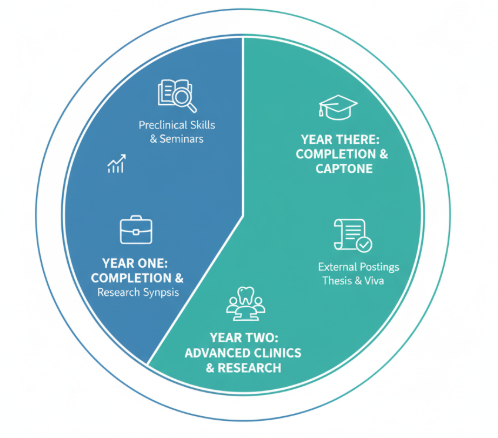
The structure advances in layers.
- Year one builds foundations through preclinical skill stations, ward rounds, seminars, and a preliminary research synopsis.
- Year two deepens clinical quotas, advanced lectures, interdepartmental meets, and ethics approval for the thesis.
- Year three completes comprehensive cases, reflective portfolios, external postings, and thesis submission, followed by a university viva.
Assessment is continuous. Logbooks record procedures, reflective notes, and outcomes. Objective structured clinical examinations are used to reduce bias and keep marking criteria clear. A typical week blends specialty clinics with case presentations, journal clubs, and radiographic interpretation sessions. The aim is simple. Graduates should examine confidently, diagnose precisely, consent ethically, and perform within safe limits.
Independent audits from teaching hospitals often note a steady fall in retreatment rates when rotary endodontics, rubber dam use, and magnification become routine. This confirms the value of methodical training over the programme.
Which Learning Methods Help Families Trust The Training Path?
Parents value clarity and consistency. The curriculum now includes case-based learning, morning reports, pre operative huddles, and structured debriefs. Students practise on simulation blocks before touching a patient. Community dentistry postings serve real needs in schools and rural camps while building communication skills. Allied workshops cover medical emergencies in the dental chair, sterilisation norms, informed consent, and digital record keeping.
Many departments in MDS colleges in North India now collaborate with radiology centres and biomedical units for exposure to cone beam computed tomography, laser units, and digital impressions. These partnerships shorten the gap between the classroom and the clinic.
How Does DJ Dental College Guide Careers Through The Programme?
Support systems matter as much as curriculum maps. DJ Dental College assigns a mentor for academic progress and another for research. A career cell conducts sessions on clinical practice setup, NABH-aligned protocols, insurance documentation, and patient communication. Students join city health camps to gain confidence with diverse cases. Thesis support includes data collection clinics, statistics help, and journal submission guidance.
Clinical records show that a supervised logbook across three years documents hundreds of patient interactions in most specialities. This breadth of contact readies graduates for private practice, hospital roles, or teaching assistantships. It also makes transitioning to fellowships smoother, especially when international guidelines and sterilisation protocols are already familiar.
How Do Students Compare Pathways Across Regions And MDS Courses?
Families often compare case mix, faculty time, and research culture. Useful indicators include seminar quality, external postings, access to microscopes, and publication mentoring. When these pieces are in place, MDS Courses consistently produce graduates who can manage endodontic crises, full mouth rehabilitation plans, cleft and trauma referrals, and periodontal surgeries under supervision. Consistent exposure builds judgement, which is the quiet skill employers and patients notice first.
Financial planning is addressed through transparent fee schedules and planned purchases for loupes, typodonts, and reference texts. Alumni meets and placement fairs add a practical window into early career choices.
Where Should Families Begin When Shortlisting MDS Colleges In North India?
Begin with three questions. Will the timetable keep clinics central? Is research support active and visible? Do seniors and faculty teach with patience? Visit the campus, read recent theses, and attend an open clinic day if possible. Counselling at DJ Dental College is designed for parents and students who want a calm conversation about specialities, case exposure, and outcomes. Our coordinators explain the timetable, walk through labs, and share sample logbooks.
For detailed counselling or a guided tour, contact the admissions desk at DJ Dental College. Our team is ready to discuss seats, specialities, scholarships, and structured support through all MDS Courses.
Related Posts